Through the mimesis of the ‘voice of the dead’ (mnemosyne, memory) that cuts a ‘ditch’ in the earth, a rift or crack in time . . . the dead return to seek revenge on the living.
GWF Hegel, Phenomenology of Spirit.
*
These ghosts have voices that come in the form of lament, of pleading and praying, apology and anger. They are strange and unfamiliar, foreign. They are not, in other words, the soothing, comforting, joyous, or even protesting, sing-a-long voices of popular music; but voices that carry a different kind of weight. They crack the surface of the present to release the air and spirits of another reality. Some ways of comprehending the coming together of these voices, apparently ventriloquized or orchestrated by Brian Eno and David Byrne, are more commonplace than the one that might take us to the core of My Life in the Bush of Ghosts’ essential truth, which might be something along the lines of we are of the world, yet apart from it.
But before we get to that there is a more conventional account of what this ‘bush of ghosts’ is. It draws on the way Eno and Byrne deployed avant-garde aesthetics within the context of popular music. They did, after all, produce in this singular piece of popular music, a kind of audio collage as soundscape. We could begin, then, with the fact that sound has ‘the mysterious ability to melt into air’; it is, as Friedrich Kittler observed, a strange kind of ‘weightless matter’. No sooner is sound recorded and preserved – whether the sound is a voice, music or birdsong – than it is made material as the fragment of a once continuous flow of time, now abstracted. ‘In one way or another,’ Jonathan Sterne writes, recording ‘destroys sound’s ephemeral qualities.’ Thus, it is useful to remember that audio recording technologies are essentially writing machines. And as with other forms of inscription, such as writing and photography, recorded sound displaces presence. As such, any act of inscription (on paper, film, magnetic tape, and so on) permits a ghostly presence to become part of our present, and how we then perceive ourselves and the world around us.
>>
This text, originally from mid-2011, reappears in expanded form in my recently published book, Memory: Encounters with the Strange and the Familiar (Reaktion, 2013). It was originally written as part of a proposal for a book on Brian Eno and David Byrne’s My Life in the Bush of Ghosts that was never written.
When phonographic technology arrives, in the nineteenth century, into a soundscape once defined by temporal duration and presence – by the fact that what you heard told you about who you were, and where you were – it releases the grip of that world, which was thereafter supplemented by the uncanny fragments of mediated sound. Like so many other modern phenomena, such fragments may appear merely as sound isolated – perhaps a voice, or music never heard in person – snatched from another time and place.
Yet reality is reconfigured here at a more fundamental level. Media, in general, remake human memory as a kind of cultural kaleidoscope. The potential to go from ‘experiencing’ displaced time – a real that is absent – in phonography, to the polychromic auditory world introduced by the possibilities offered by the medium of magnetic tape, takes recorded sound yet further into ‘reverie, myth, and fantasies of cosmic journeys’.
Unlike the hard format of early recordable sound media, tape was characterised by its pliability and the fact that it afforded greater artistic potential – it could be cut, spliced, looped and doubled – to produce ‘powerful and paradoxical technoconceptual’ syntheses employing ‘repetition and mutation, presence and delay’.
In France during the late 1940s and 1950s Pierre Schaeffer developed a technique that was later called musique concrète. Alongside others in the Group de Recherche de Musique Concrète he employed magnetic tape technology to ‘harness sound’s intrinsic ambiguity or malleability’. This produced a new kind of music that played upon ‘the technological mechanics, physics and inherent nuance of sounds as revealed through the properties of phonograph records, magnetic tape and the recording studio’. The object of musique concrète was the real environment of sound and, in practice, it sought to utilize fragments of ‘noise’ (or non-musical sounds) to create an electroacoustic equivalent of a Kurt Schwitters collage. For visual artists working in collage, as George Steiner wrote, the idea was to mine the detritus of everyday life for its aesthetic potential. Thus Schwitters would compose using the fragments of everyday life: ‘used tram tickets, cloakroom tokens, beer mats, scraps of newspaper, candy wrappers, splinters of glass and metal, wood-shavings, chicken-wire, bits of discarded string,’ and so on. In musique concrète, as Pierre Schaeffer recalled, the aim was much the same, but directed towards ephemeral sounds. Its own reality, for instance, consisted of such phenomena as ‘thunderstorms, steam-engines, waterfalls, [and] steel foundries,’ which were recorded and then ‘manipulated to form sound structures’.
Unlike the contemporaneous experiments with sound being produced in Germany by the movement that went by the name of Elektronische Musik, bricolage was more important in musique concrète than composition; plundering the auditory unconscious more of a method than synthesizing sounds that a listener could not associate with the real lived environment. But magnetic tape’s capacity to warp time, space and memory was particularly marked when it came to the use of the human voice.
In the early tape works of Steve Reich (most notably two mid-60s pieces, ‘Come Out’ and ‘It’s Gonna Rain’), the human voice was made to ‘mutate and transform kaleidoscopically’ under the action of machine agency, slipping in and out of sync, ‘to capture poignant, contradictory moments in the sonic equivalent of what [Walter] Benjamin referred to as the dialectical image.’
In Benjamin’s work, as Ben Highmore observes, ‘everyday life registers the process of modernization as an incessant accumulation of debris’. And it was through the medium of debris, raised to the level of the aesthetic, that he thought we might be awakened from the dreamworld of modernity’s perpetual present. The possibility of a new consciousness of time and progress lay behind his own Arcades Project, which itself piled up fragments (quotations, observations and aphorisms) in a kind of literary montage inspired by the ideas of Surrealism, and which itself could be seen as a distant literary precursor of My Life in the Bush of Ghosts. Benjamin thought that such detritus, when placed in the right combinations and juxtapositions, would allow the dead world of modernity past to come into its own.
Benjamin’s term ‘dialectical image’ should not be taken to refer simply to ‘images’ in a visual, or photographic, sense. Rather the word ‘image’ here refers to something closer to thought-image – perhaps a kind of dreamlike synthesis: ‘the realization of dream elements in the course of waking up is the canon of dialectics,’ he once wrote. The dialectical image thus fuses time, experience and memory to suggest new possibilities or an otherwise concealed reality in which things put on ‘their true – surrealist – face’.
My Life in the Bush of Ghosts might be one remarkable example of how this can be understood in terms of the materiality of modern auditory culture. Described by Eno at one stage as a kind of ‘garbage disco’ because it was composed of a variety of found sounds, the album was a collection of audio collages that to a large extent took the form of popular song. Following the tradition of musique concrète, everyday objects found lying around the studio – cardboard boxes, ashtrays, and tins – were used in place of traditional musical instruments. More crucially, though, was the use of the voice. As had been the case with Steve Reich’s early tape works, Eno and Byrne also featured the voice as the most prominent presence. Thus, at one level, the radio evangelist, the spiritual singers, the duplicitous politician and, on one piece, ‘unidentified exorcist’ constitute the ghosts of the album’s title.
But, at another level of understanding, we see yet more ghosts – not merely those that are the effect of technology’s uncanny properties.
Imagine, if you will, Roget’s Thesaurus as the most fantastical and orderly inventory of self and other yet contrived by the human mind in order to come to terms with how experience has, thus far, been understood and accounted for. Everything, we learn, begins with one fundamental opposition: there is existence, and there is non-existence. From there, all language, all understanding, may be derived. To seek further is to see that all the subordinate clauses that attach to life and death end up strangely concealing the dependence of these two conditions beneath an endless elaboration of phenomena that offer the protection of disguise.
Yet force any of the opposing tendencies or domains into collision and you find paradoxes, indeterminacy, and the unconscious. Soon, you raise to life a world of ‘intuition, revelation and inspiration, and of in-between media like air, angels and spirits.’
One ‘level’ beneath the fundamental opposition of all that is living and dead in our inventory we find ghosts, simulacra of the real. As emanations of ‘another place and another time’ they return as a kind of counter-memory that lays claim to the present, or at least threatens to catapult us back into some mythic temporality where forces beyond our control dominate, causing ‘the descent of a living person into the underworld for the purpose of finding out – and seeing – what he wants to know.’ Hadn’t this always been the aim of both Eno and Byrne? To mess with the notion of artistic self-expression that had, post-Bob Dylan, so hamstrung rock music? Eno’s well-known ‘oblique strategies’ are one obvious example of this desire to be taken over, to be ‘possessed’, guided by some other force.
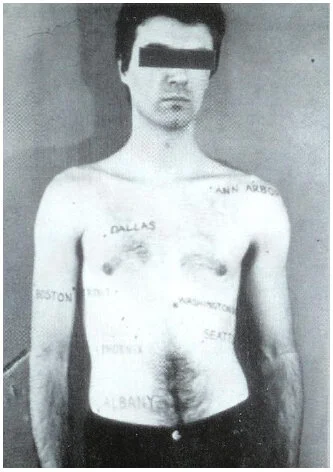
David Byrne as Map of the United States, 1973
But we see it all the way through Byrne’s career, from his earliest – and mostly unknown days – as a performance art student at the Rhode Island School of Design, for instance, where he once posed in a photograph as a living map of the United States, eyes blanked out in denial of self; a surface, a medium, on which some other thing could write itself. Then there’s the cover of 1997’s Feelings album, a GI Joe-style doll accompanied by the words, ‘David Byrne doll does not walk without assistance’ … the examples could continue.
The realm of ghosts, of possession and loss, leads us back inevitably, it seems, to myths. Ancient myths especially reveal the dangers of dabbling with the past and disturbing the supposedly dormant or exhausted forces that were likely just lying in some temporary slumber, as if waiting to be roused. In Virgil’s Georgics the ghosts – or ‘shades’– from the underworld are conjured up by the music of Orpheus, to be found amidst the leaves of a bush:
But, by his song aroused from Hell’s nethermost basements,
Flocked out the flimsy shades (ghosts), the phantoms lost to light,
In number like the millions of birds that hide in the leaves.
In My Life in the Bush of Ghosts, Eno and Byrne bring the spirits close. They entertain possession by something that might move them, pull them back into a time and place where self was unimportant – as if they were anonymous scribes, or mediums through which the dead come to take possession of the living.