This is the opening section of my article ‘Duchamp’s Wager: Disguise, the Play of Surface, and Disorder’, History of the Human Sciences, Vol. 16: 3 (2003), pp. 1-20:
In the early 20th century the principles that had underpinned most avantgarde western art since the early 19th century seemed yet to have an impact on (or could still be ignored in) the work of some influential but more classically directed scholars who developed connections between aesthetics and cultures of play. Whilst Friedrich Schiller, in his letters on aesthetics, had insisted on the importance of the 'play-drive' in liberating beauty and aesthetic response from formal constraints, others played down the autonomy this granted the imagination.' In Homo Ludens, his study of the play element in culture (originally published in 1938), Johan Huizinga drew a sharp distinction between poetry, music and dance on the one hand, and the plastic arts - painting and sculpture - on the other? Huizinga observed that the dependence of the plastic arts on matter - clay, paint, canvas - accounted for the difficulty in identifying this sphere of artistic activity with what he called 'free play', meaning an activity that was without any external goal, or that was not limited by any external or material constraints. Painters and sculptors, he believed, were denied lasting access to the play impulse because, unlike the poet or musician, they were required - limited - by the medium:
To fix a certain aesthetic impulse in matter by means of diligent and painstaking labour [... the artist's] inspiration may be free and vehement when he 'conceives', but in its execution, it is always subjected to the skill and proficiency of the forming hand. (Huizinga, 1955: 166)
The point Huizinga was making was that once an object is fixed - made material - it is effectively captured in time and space, purely as a consequence of its materiality, and so fully present to the senses and incapable of realizing a fluidity of expression found in the other arts. Thus 'where there is no visible action [i.e. in finished painting and sculpture] there can be no play' (Huizinga, 1955: 166). The object of plastic creation as realized therefore brings to an end the indeterminate motion of play that is found in artistic creation.
Read the article HERE [link]
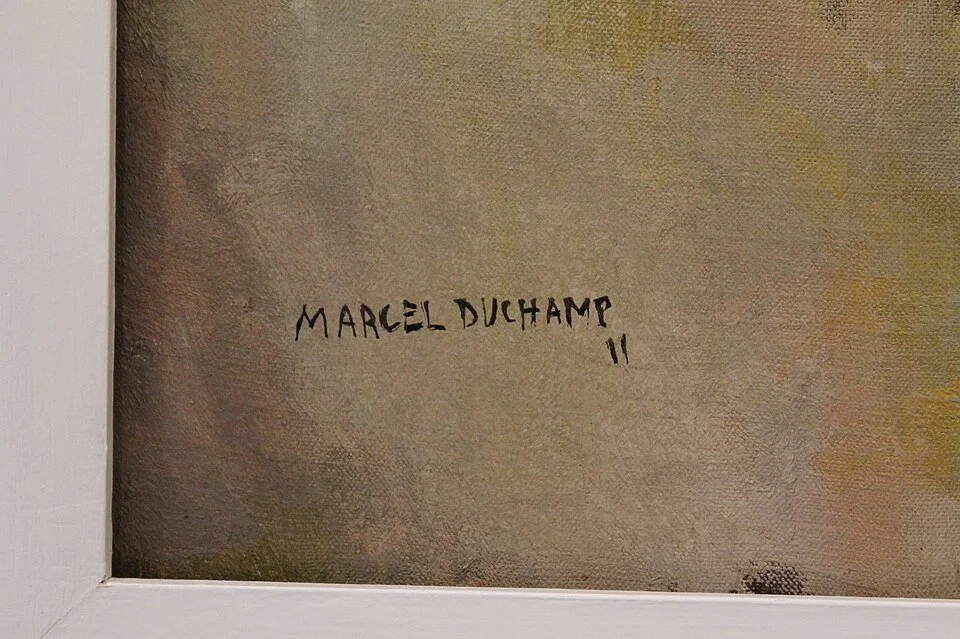
Image: https://commons.wikimedia.org/wiki/File:Marcel_Duchamp_signature.jpg
