What counts is to jump out of the twentieth century as fast as you possibly can in order to create an environment that you can truthfully run wild in.
Malcolm McLaren
*
Julien Temple, the earliest chronicler of the Sex Pistols, has described the first time he encountered them as being akin to witnessing an alien visitation: four figures, silhouetted against the light, making a racket of a noise inside a darkened warehouse that was located amid the ruins of London’s docklands – a site, in fact, that had been deemed irrelevant and redundant just a few years earlier. Johnny Rotten, the singer of this group, with his unusual spiky hair – which might have been dyed green, perhaps orange – was clad in a fuzzy striped mohair sweater and a pair of trousers that disobeyed the current fashion for denim flares that skirted the floor. He contorted himself into unnatural shapes. And, with a pair of thick rubber-soled brothel creeper shoes seemingly sucking him to the ground, his hands gripped a microphone stand as his limbs moved, marionette-like, as if he had no control over himself. This was August 1975, and Rotten looked like he belonged on another planet.
It had been just a few weeks since the Sex Pistols had started to rehearse with Rotten, their newest member. As Temple watched, he might have had little sense that he was standing just a mile or so from the prime meridian at Greenwich, a spot that had, since the nineteenth century, assumed something like the status of the centre of the world. If it wasn’t that exactly, it was at least the precise point at which the globe was definitively split into east and west: the earth’s eastern hemisphere lying to one side of the line, its western hemisphere to the other.
But there, at that moment, the sense of place – London, England – was reconfigured inside the peculiarities of that time: the 1970s, an era marked by an economic decline and existential unease, when the end of empire was symbolized by the wasteland that had replaced the once thriving docks.
There was the past, and there was a future, the shape of which could never quite be known. But the near future, a quickening of the present, was always at hand, if only you could sense it, or catch a glimpse of it. This is where the Sex Pistols would exist for something like the next two years – until early January 1978 – always running ahead of, and out of, time.
More Details
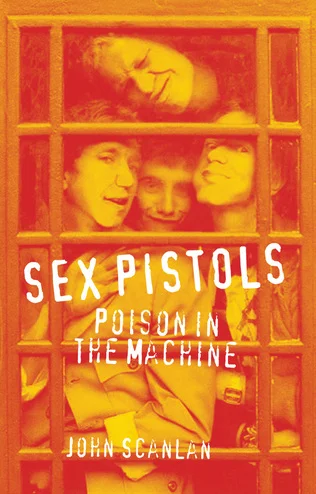
This is the ‘Preface’ from my book, Sex Pistols: Poison in the Machine (2016), published recently by Reaktion. © John Scanlan.
Editions:
Reaktion (UK), 2016
University of Chicago Press (US), 2016
Malcolm McLaren, who might be described as the originator or instigator of the Sex Pistols as an idea or event (it is misleading to describe him simply as ‘their manager’), once renamed the shop that he owned ‘Too Fast to Live, Too Young to Die’. It was a slogan that was in part inspired by the legend of James Dean, who crashed to a premature death racing in a sports car, but perhaps also by the devil-may-care attitude of motorcycle rock ’n’ roll enthusiasts, who wore it as an emblem on their black leather jackets as they hurtled at great speeds across the nearby Chelsea Bridge, where since the 1950s they had staged deadly illegal contests. It also signified something that the Sex Pistols embodied, and that McLaren had always wanted them to embody: all of the demented radicalism of youth as it ran towards its own kind of nihilistic self-destruction.
That is what history seems to suggest the Sex Pistols were always about. They were too fast to live. They were almost designed to fail, and their actions met with predictable consequences. But their recklessness accounts for why historians of twentieth-century popular culture say there is before the Sex Pistols, and there is after the Sex Pistols: they stepped out of their surroundings and signalled the future. However familiar the format of their music appears to us today, it said something greater than popular music typically does, something that was not just about them, and it did so in such a way that it marked not only a decisive break in the culture and history of popular music, but in twentieth-century Britain.
*
In many ways, the story of the Sex Pistols reveals that in the 1970s Britain seemed to be caught in some kind of temporal disorder – it seemed to be going backwards and forwards at the same time. The very perception of the future, as J. G. Ballard once remarked, seemed to have defined the twentieth century like no other before it:
Every year planes were doubling their speed, and then after the war we had antibiotics, computers, motorways were being laid down. People were constantly predicting what the future was going to be like in ten or fifteen years, and all those vast futurama exhibitions were sources of enormous pride.
However, after two or three decades of sustained acceleration into this near future after the interruption of the Second World War, the London of the early-to-mid-1970s, if viewed askance, could easily seem to belong to a world that was entering a phase of marked and perhaps irreversible decline. In 1974, as the British government pressed ahead with the development of the super-futuristic Concorde – designed for ‘supersonic’ passenger travel – the public had meanwhile grown used to gathering around candles for half the week as power outages brought the country to a near standstill. And not long after the country had emerged from the twilight of the three-day week, a consequence of those power shortages of 1974, it nevertheless often presented a shabby, grey exterior, bearing the traces of a heavy industrial past in the soot-covered facades of its great landmarks.
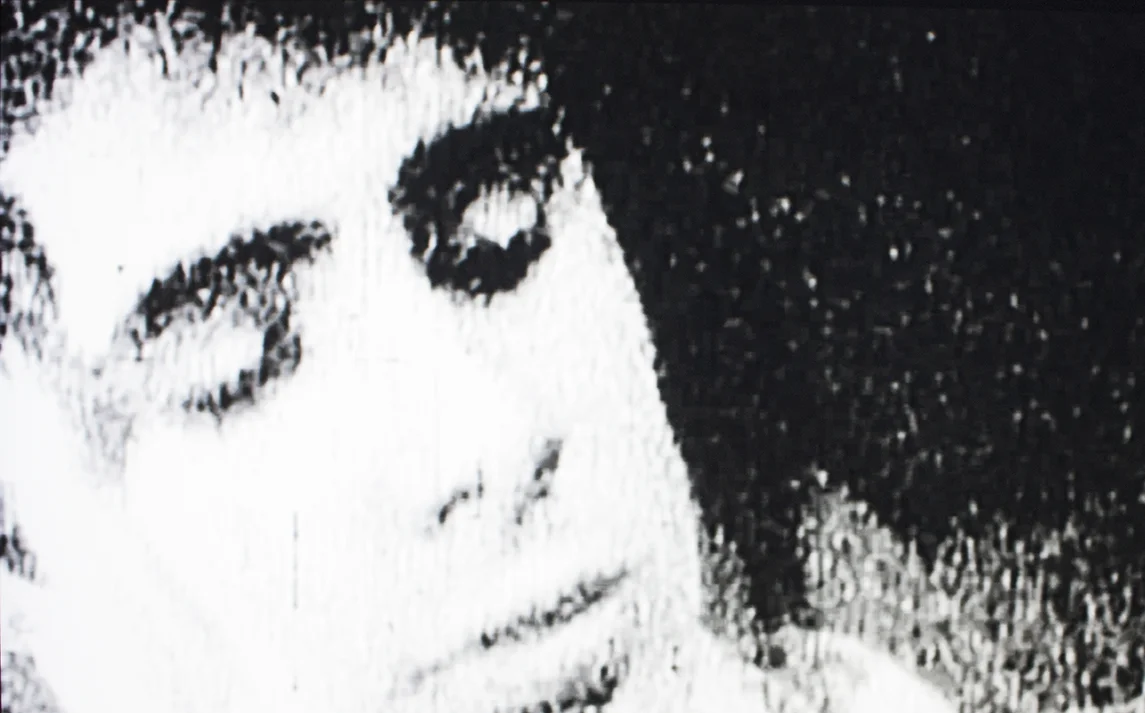
Glen Matlock. From Derek Jarman’s Super-8 footage of the Sex Pistols, February 1976.
Present-day London tourist locations such as Covent Garden had been all but abandoned, and elsewhere pockets of the city still looked as if the Blitz had been a recent occurrence. For many in those days of relative media scarcity, leisurely hours were quite often confined to the kind of dilapidated street-corner pubs that could be found up and down the country, and which seemed to be closed more often than they were open. By the summer of 1976, when the Sex Pistols suddenly burst into public consciousness as the apparent leaders of some new phenomenon called punk rock, it was apt that it was during the ‘equatorial’ conditions of July and August, when the country seemed to be ‘boiling up, partly with crisis, partly with rage’, as Martin Amis wrote. ‘Everything seemed ready for the terminal lurch.’
If it is true to say that by 1976 Britain was practically bankrupt, it is equally true to say that economic woes alone do not account for the sense of boredom and anomie that seemed to propel into existence a band – and, in punk, a phenomenon unlike anything before or since – that came to be viewed in almost apocalyptic terms. The labelling of punk as ‘dole queue’ rock may have had some relevance as it related to the rash of new groups that sprung up after the Sex Pistols, and insofar as it referred to the fans all over the country and beyond who embraced those bands. But the Sex Pistols’ origins lie elsewhere. As Jon Savage – author of England’s Dreaming: Sex Pistols and Punk Rock, the definitive witness account of the entire phenomenon – has said, to see punk in terms of dole queues, or simply in terms of ‘social realism and rock music’, is a mistake: ‘It was for a brief period very futuristic.’ As Malcolm McLaren put it, the point was to step out of the twentieth century and into the future.
*
The story of the Sex Pistols, or some version of it, has been told and retold so many times that whatever it was they expressed or represented has been obscured by the way we now look at, and engage with, the past. While the passage of time has, on the one hand, made the 1970s seem like an often strange and unusual period of recent history – like a distant ‘other world’ we have travelled far from – we also live, on the other hand, in an era of present pasts, which are the product of ‘cultural memory’. Cultural memory, in a sense, changes how we understand the relationship between the past and the present, precisely because it aims to bring the past into the here and now. And it is through the apparatus of cultural memory – the panoply of media artefacts, material objects and memoirs that feed into various forms of reanimation (film documentaries, commemorative events, exhibitions and so on) – that the Sex Pistols seem close to us. Yet for those who lived through the events that marked the rise and fall of the Sex Pistols, there was no all-embracing perspective that could sum up what was happening, what the Sex Pistols were about or where they were heading. In their time the Sex Pistols scandalized the population of a country that had, most remarkably of all, probably never even seen or heard them, except through the outraged shock headlines of the tabloid press. Today, however, they are everywhere. Anyone can now see them, listen to them, read about them and follow their fates in the afterlife of their seminal moment.
While the media-saturated world we now live within seems, on the one hand, to bring the lives and times of those who created this phenomenon into view – the Internet, for instance, is awash with sounds, images and film footage of the Pistols, unseen and unheard at the time – and allows us to see them now, in some ways, more in context than ever before, it nonetheless also dampens the power of the Sex Pistols as an event unlike any other, and helps to obscure and neutralize what was an explosive cultural moment. Their headline-grabbing appearance in December 1976 on the Today programme – the so-called ‘Grundy Show’ – during which Steve Jones, the Sex Pistols’ guitarist, fell into one of the most memorable bouts of swearing ever seen on television – genuinely shocked a nation, and turned a run-of-the-mill TV promo into something whose cultural consequences are hard to comprehend today.
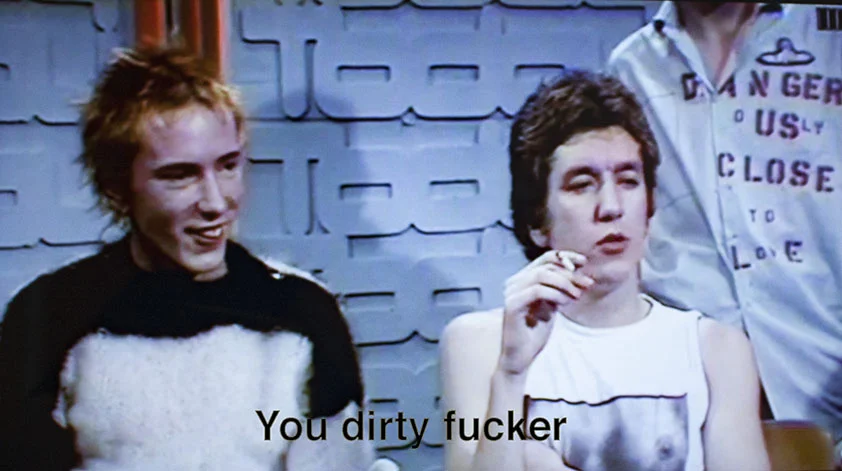
On the Today programme, December 1976.
In the words of Steve Severin who was there in the television studio, seeing it replayed over and over on television throughout the years has turned it into something ‘like the moon landing or Kennedy being shot, not something you actually participated in’.
The fact that the footage of the event exists on the Internet to be replayed at will today is a matter of chance. Julien Temple, engaged by Malcolm McLaren in 1976 to document the Pistols, managed to track down one of the then rare people who possessed the equipment to record television broadcasts. He then re-filmed the clip from a TV set playing the videotape of the show, and now it is an ever-present, free-floating fragment of a vast and seemingly infinite digital cultural archive. Out of its time and its place, however, the event is something different.
Today it might look quaint or tame, leaving us wondering what all the fuss was about. If it does, it is because it has so successfully come to exist outside of the context of 1970s Britain. What’s probably even stranger to us today is that at the time most of the country never actually saw the show in the first place – Thames Television was only broadcast in Greater London and some other parts of the south of England. The news of the Pistols’ exploits spread, like rumour of some alien invasion, through shock headlines, not replays of the television footage. By the beginning of 1977 the band was already taking on mythical proportions, a situation that continued to develop as it became more difficult to hear and see them due to the combination of media blacklisting and performance bans that, in the end, led to only greater infamy. Like every good myth, by the time it reached those most distant from the actual events, the story had become something much larger than it originally was.
As a musical phenomenon, the Sex Pistols were remarkably short-lived. Throughout an existence that lasted little more than two years, the media perception of the band was shaped by the way that Malcolm McLaren – for a while – seemed able to deploy the notoriously scandal-hungry tabloid press like so many pieces in a game he actually had no control over, but was making up as he went along. From there, the Pistols faced repeated attempts by the forces of respectability to cast them back into a demi-monde of freaks, villains, rubber fetishists, junkies and prostitutes that the public believed they must have sprung from. It was a perception that was not entirely without foundation. The band’s origins, after all, were in Malcolm McLaren and Vivienne Westwood’s King’s Road boutique, SEX – which was more an expression of a political-aesthetic idea than it was simply a shop – for which they were initially intended to be a vehicle. The Pistols’ early followers were, in the words of one of them, ‘the most bizarre carnival of subterranean people’.
It is perhaps remarkable that the Sex Pistols managed to produce any records at all. In fact, their one and only official album released during their existence, Never Mind the Bollocks, Here’s the Sex Pistols, emerged after more than a year of false starts, towards the end of 1977, and after a host of other bands whom they had inspired had released their own records. Following their sacking from two major record companies and the withdrawal and non-appearance of records due to factory workers refusing to handle Sex Pistols product in late 1976 and early 1977, not much had emerged to reach beyond the eyes and ears of the few who had actually witnessed the Pistols in person, although they had by then recorded more than a full album’s worth of material. But what had been released in dribs and drabs was enough to cause the authors of 1978’s Illustrated New Musical Express Encyclopaedia of Rock – a book that went to press before the Pistols’ album was released – to declare that their first three singles (‘Anarchy in the UK’, ‘God Save the Queen’ and ‘Pretty Vacant’) were ‘arguably the most powerful sequence of debut releases rock has ever seen’. By the time that book was in the hands of most readers, however, the Pistols were no more.
This gap between the reality and its representation – so at odds with the world we live in today, where the gap is non-existent – also added to the perception that the Sex Pistols had, by 1977, already entered the realms of myth. In fact, by the end of 1977 the punk phenomenon beyond the Pistols had arguably lapsed into self-parody as musicians and record companies, sensing their opportunity, joined the bandwagon. The Pistols themselves had also begun to come apart during the summer of 1977, and John Lydon would extract himself from what had become an unbearable situation in January 1978, as the media frenzy surrounding the Sex Pistols’ tour of America became uncontrollable.
This is a book about something more than a bunch of people who once made some music that we still listen to today. It is about the times, the ideas, the coincidences and the characters that led up to and played a part in a year of self-destruction that began in December 1976, and ended early in January 1978 when the Sex Pistols – beaten, bloody and overdosed – ceased to exist.