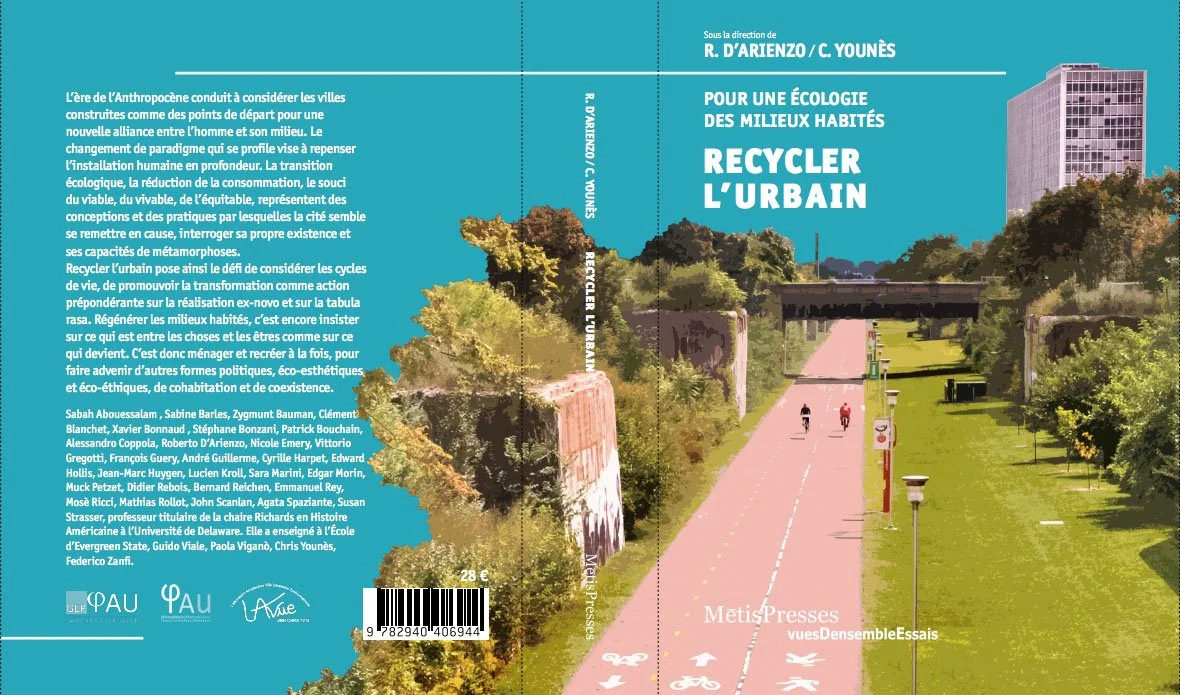
An article titled ‘The Language of Waste’ has been published in Recycler l’Urbain: Pour une écologie des milieux habités (Geneva: MetisPresses, 2014). I think my contribution, along with Zygmunt Bauman and Susan Strasser’s, are the only essays in English in this volume, which is one of three of a series edited by Roberto D’Arienzo, Chris Younès and others.
In lieu of an abstract here are the first three paragraphs of my article:
The language of waste has often been employed to describe a world that seemed caught in some kind of downward spiral; a shadowy realm characterized by phenomena that had been declared worthless or disgusting. But the language of waste also seems to reveal the extent to which it has become a defining characteristic of western modernity – specifically in the sense that it tends to be manifested as a special kind of temporal awareness or sense of finitude.
If we reflect on the language and terms of debate around the idea of sustainability that we are now increasingly familiar with, we don’t have to look far to see that it rests on a desire to reduce or minimise waste that is itself shaped by the need to fix our collective gaze on a horizon that surpasses the here and now. To think in the language of sustainability means that we have recognized the consequences of the lives we now live and the choices we make; and that the shadowy realm where the wastes have hitherto been banished to demands our attention.
But while the language and terminology of ‘sustainability’ – which sees potential resources in waste – is commonly attached to large issues (the future of the environment, the planet, or human society thousands of years from now) the language of waste still allows us to comprehend more circumscribed or local ‘problems’ and solutions, all of which contribute to an understanding of how difficult it is, and has been to consider the possibility of a goal such as the goal of zero waste.
More information about this and the other two volumes can be found here:
https://www.metispresses.ch/fr/recycler-l-urbain